
Categories Culture

How to Stereotype a Whole Nation Based on a Netflix Show


The power (and danger) of pop culture in shaping cross-cultural perceptions

Photo by charlesdeluvio on Unsplash

Ah, Netflix: the great equalizer, the modern-day UN of entertainment, where everyone has subtitles and no one has context.

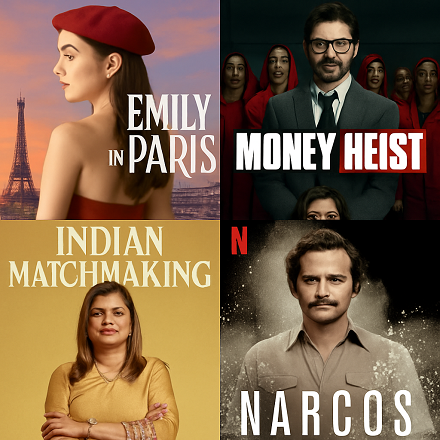
It’s 3 a.m., you’ve just finished binge-watching Emily in Paris, and suddenly you’re an expert on French culture. You know the French don’t work, they smoke during meetings, wear berets at birth, and cheat on partners as casually as they order croissants. You now pronounce “Louis Vuitton” with a nasal “oui,” and every city break must include red wine and a tragic love affair.

A Still from Emily in Paris

Congratulations! You’ve just stereotyped an entire nation based on a Netflix show. You’re officially a global citizen—with a dangerously limited worldview.


Step 1: Watch One Show. Assume it Represents an Entire Country.

Netflix offers thousands of hours of curated fiction, so clearly one show must be the cultural Rosetta Stone, right?

Watched Money Heist? You now believe Spaniards spend their days in red jumpsuits rebelling against capitalism, while listening to “Bella Ciao” on loop.
Loved Narcos? Colombia is now one giant cocaine farm with Pablo Escobar’s face on the flag.
Saw Indian Matchmaking? Ah yes, every Indian woman is either a “face reader” or a victim of their mother’s disappointment.

Narcos

Because why visit a country, read a book, or—heaven forbid—talk to actual people from there when you can just let Netflix algorithms guide your cultural literacy?


Step 2: Forget Nuance. Lean Into the Cliché.

Netflix doesn’t do subtlety. Why should you?

  • British people? Emotionally constipated, well-dressed, and have sex only in period dramas.
  • Americans? Either superheroes, serial killers, or lawyers who yell “Objection!” every 30 seconds.
  • Italians? Love food, family, and shouting in scenic piazzas. (Bonus points if they have mafia connections or a Vespa.)
  • Koreans? All brooding chaebols, supernatural beings, or both—who fall in love in slow motion during cherry blossom season.

It’s not racism. It’s cinematic shorthand, darling.


Step 3: Ignore Who’s Telling the Story

That Korean drama you love? Produced by a U.S. company with input from five Western executives and test audiences in Minnesota.
That “authentic” Indian series? Co-written by someone who hasn’t lived in India since 1997 but owns a yoga mat from Urban Outfitters.

Netflix’s cultural content is often filtered through a lens of exportable exotica. It’s not about representing a nation accurately—it’s about selling it stylishly.

Spoiler alert: You’re not seeing a country. You’re seeing its international marketing strategy.


Step 4: Spread the Gospel

Once you’ve watched enough TV, it’s time to educate others.

“You’re from Japan? Omg, I loved Alice in Borderland. Is Tokyo really that dystopian?”

“You’re South African? Wow, Blood & Water was incredible. Is everyone in your school that attractive?”

“You’re from Sweden? Please tell me your life is like Young Royals. And also, explain IKEA.”

Nothing says cultural sensitivity like assuming real life mirrors plot lines designed for dramatic tension, cliffhangers, and optimal viewer retention.


The Real Danger: When Fiction Becomes Foreign Policy

Jokes aside, the way we consume media does shape how we see the world. Studies show people unconsciously absorb stereotypes from entertainment, even when they “know” it’s fictional.

If all you know about Latin America comes from Narcos, you may subconsciously associate the region with drugs and violence. If your only exposure to Arabs is via war-torn backdrops and terror plots, you might internalize fear rather than curiosity.

And therein lies the problem.

Media is not just entertainment. It’s soft power. It sets narratives, legitimizes biases, and quietly builds walls in our heads—even as it claims to broaden our horizons.


What Can You Do Instead?

  1. Watch critically. Enjoy the drama, but ask who’s behind the scenes and what perspective is being presented.
  2. Diversify your media diet. Explore films, books, and creators from the culture you’re interested in, not just about it.
  3. Talk to real people. No, seriously. Reddit doesn’t count.
  4. Admit what you don’t know. It’s sexy. Humility is hot in all cultures.
  5. Don’t assume nuance can be binge-watched. Culture isn’t a plot twist you can figure out by episode 4.

Final Thoughts: Satire is Fun, But So is Empathy

Let’s be honest—we all stereotype sometimes. It’s human. The brain loves shortcuts. But when entertainment becomes our only lens, those shortcuts become dangerous detours.

So yes, laugh at Emily in Paris. Cringe at Indian Matchmaking. Marvel at Lupin. Just don’t forget: real life is always messier, funnier, and infinitely more complex than the Netflix algorithm could ever predict.


Author’s Note:
If this post offended your national identity, blame Netflix.
If it entertained you, please stereotype me as “that witty blogger who understands culture.”
I can live with that.


You May Also Like

How to Destroy a Museum Visit in Under 5 Minutes

Think museums are about reverence and reflection? Wrong. Here’s how to wreck centuries of history in five minutes flat—by selfie-ing with mummies, speed-running plaques, and loudly mispronouncing every ancient name like it’s a party trick.

Read More

What Not to Do in a Job Interview (If You Don’t Want the Job)

So you’ve landed a job interview. Congratulations! Time to blow it spectacularly. Whether you’re plotting your escape from corporate drudgery or just conducting social experiments with HR personnel, here’s your foolproof guide to making sure you never get a callback. Of course, if you do want the job, simply do…

Read More

The Easiest Ways to Be the Least Interesting Person in the Room

(And how to avoid becoming human background noise) Picture this: You’re at a dinner party. People are chatting, laughing, bonding over spicy hummus and childhood trauma—and there you are, nodding like a bobblehead, clinging to your drink like it’s your emotional support chalice. Everyone drifts away one by one, and…

Read More